A Swampbuster violation can cost you every federal farm program payment you receive — crop insurance, ARC/PLC, CRP, disaster payments — all of it. We help farmers navigate wetland compliance and challenge incorrect determinations.
The Swampbuster provisions of the Food Security Act make it illegal to produce agricultural commodities on a converted wetland or to convert a wetland for agricultural use. The penalty for a violation is the loss of all federal farm program benefits — not just conservation programs, but crop insurance, ARC/PLC, disaster payments, and FSA loans.
For a farm that relies on crop insurance and commodity program payments, a Swampbuster violation can cost tens or hundreds of thousands of dollars per year — indefinitely, until the violation is corrected.
The most common trigger is drainage. Installing new tile, cleaning a ditch, filling a low spot, or even farming through a wet area that NRCS later classifies as a wetland can trigger a violation. Wetland boundaries are not always obvious, and NRCS determinations can be based on outdated data.
If you receive a Swampbuster violation notice, you need legal counsel immediately. This is one of the most critical issues we handle in our water and drainage practice. The determination can be appealed, and exemptions may be available — good faith violations, minimal effect exemptions, and certified wetland delineations.
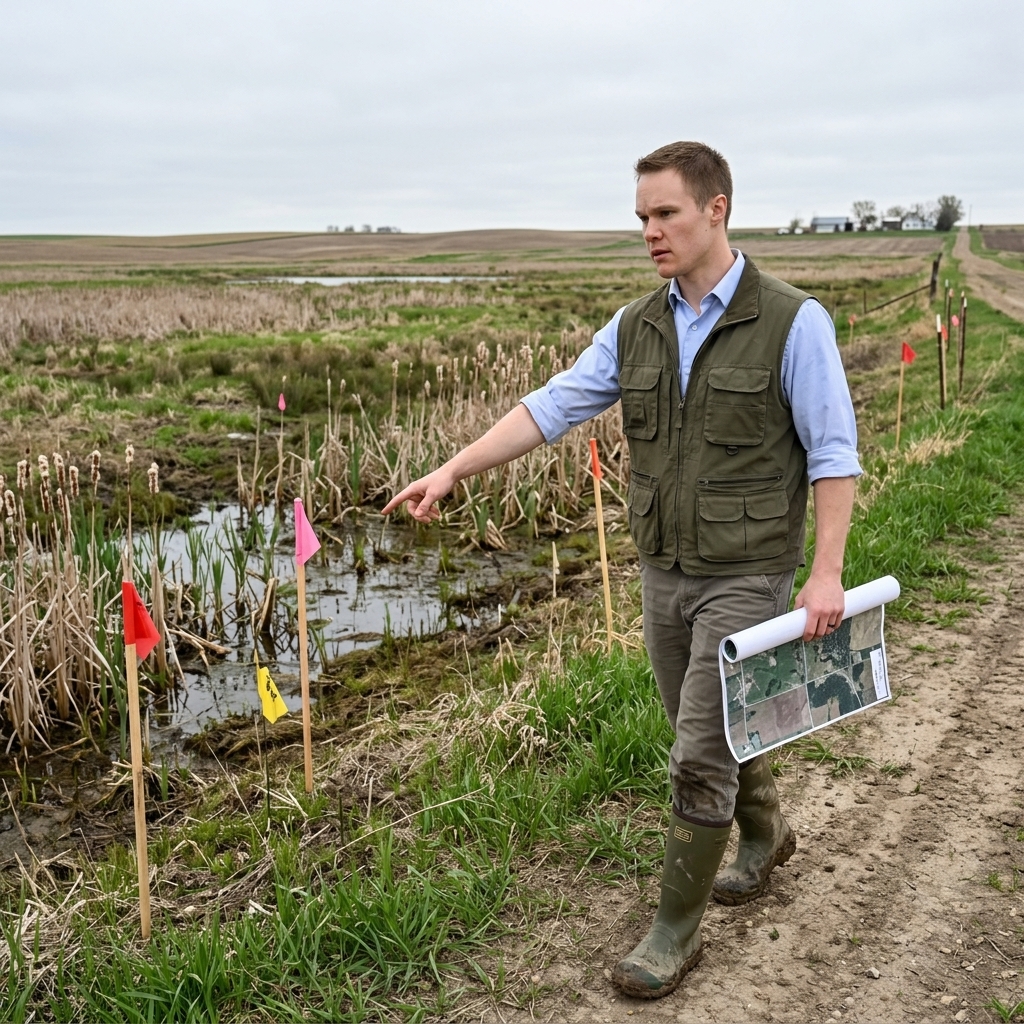
NRCS wetland determinations are based on three criteria: hydric soils, hydrophytic vegetation, and wetland hydrology. All three must be present for an area to qualify as a jurisdictional wetland under Swampbuster.
The problem is that field determinations are sometimes made using desktop analysis — aerial photos and soil maps — without a thorough on-site evaluation. A spot that holds water after a heavy rain is not necessarily a wetland. A low area with cattails growing in it may have been drained and farmed for decades before NRCS decided to look at it.
When we challenge a wetland determination, we bring evidence: historical aerial photography showing the area was farmed for decades, soil boring data showing non-hydric conditions, hydrological analysis, and testimony from longtime neighbors and operators who know the ground.
We also pursue available exemptions: the “good faith” exemption for farmers who unknowingly violated, the “minimal effect” exemption for small or negligible conversions, and “prior converted” status for areas that were drained before December 23, 1985.
We don’t do hourly billing, and we don’t hand you a stack of paper and wish you luck. Our process is designed to be transparent, thorough, and completely finished when we’re done.
When you receive a Swampbuster notice, we review the determination immediately. We identify the basis for NRCS’s classification and assess whether it can be challenged.
We gather historical aerial photos, soil data, farming records, and hydrological evidence. If needed, we engage independent environmental consultants to conduct a formal wetland delineation.
We pursue every available defense — challenging the wetland classification, demonstrating good faith, seeking minimal effect exemption, or establishing prior converted status. We represent you through NRCS, the State Conservationist, and NAD if necessary.
Protection against the most severe federal farm penalty.
We challenge incorrect NRCS wetland determinations using historical evidence, soil data, and hydrology analysis.
If you’ve received a violation notice, we pursue all available defenses — good faith, minimal effect, prior converted status, and appeal of the underlying determination.
Before you tile, drain, or alter any field, we help you understand wetland boundaries and compliance obligations to avoid triggering a violation.
Reality: Not true. NRCS determinations can be challenged and overturned. We’ve helped farmers get wetland classifications reversed through evidence-based appeals. The government makes mistakes, and the appeals process exists for a reason.
Reality: They can — unless you have documentation showing the area was converted before December 23, 1985 (“prior converted” status). If you can prove prior converted status, the area is exempt from Swampbuster. Historical aerial photos and farming records are critical evidence.
Whether you need a wetland determination appealed or want to plan drainage without triggering Swampbuster, schedule a free consultation.
Legal services tailored to agriculture
Tell us what's going on. We'll point you in the right direction.
Free Consultation