No obligation. No hourly billing. Tell us about your operation and we will reach out.
100% Confidential. Flat-fee pricing.
LLCs are the right choice for most family agricultural business operations. But there are situations where a corporation or cooperative makes more sense.
S-Corporations offer pass-through taxation like an LLC but with a key payroll tax advantage: the profit distributions paid to shareholder-employees are not subject to self-employment tax, which can save thousands annually.
C-Corporations may be appropriate when retaining earnings at lower corporate rates or when stock issuance to outside investors is planned.
Cooperatives are member-owned organizations common in feed mills, grain elevators, equipment sharing, and marketing cooperatives.
Both Nebraska and Minnesota have strict anti-corporate farming laws that restrict which types of corporations can own agricultural land.
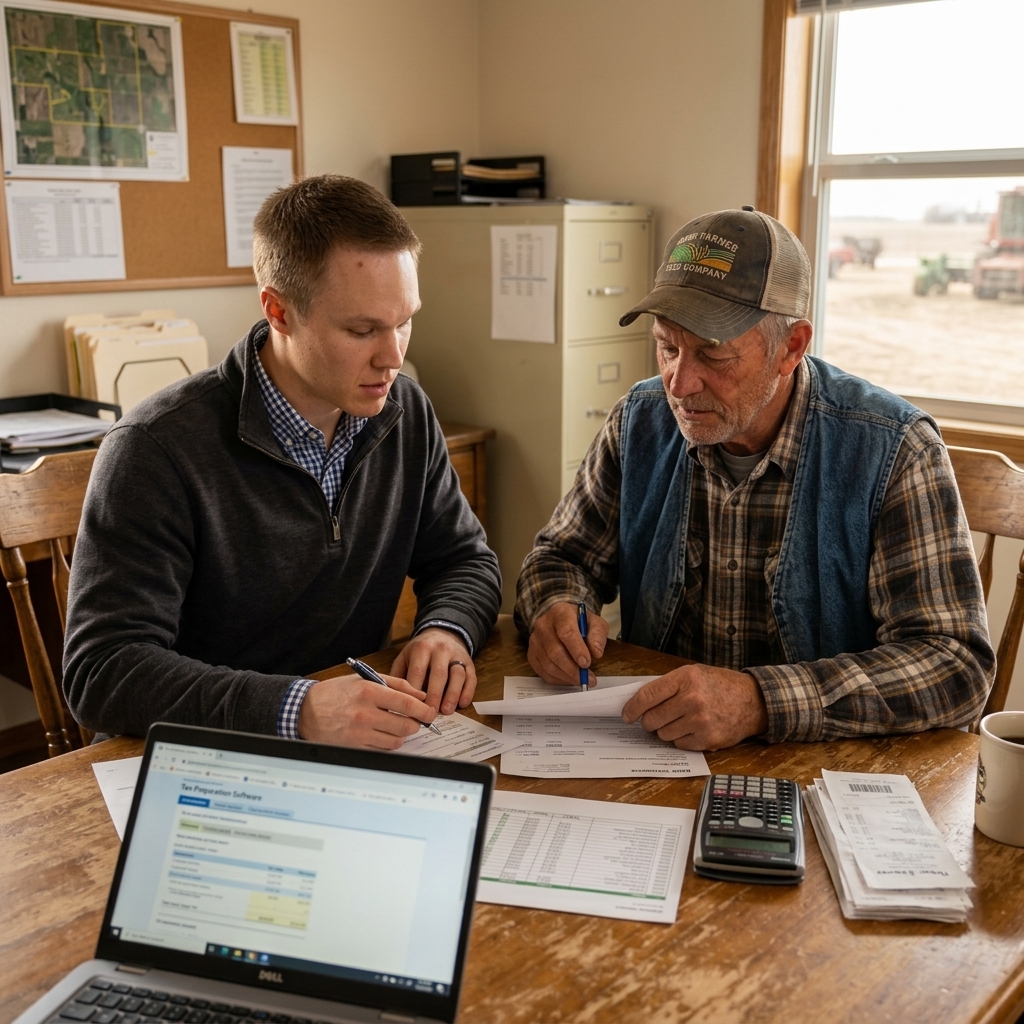
One of the most powerful — and most misunderstood — tax strategies for profitable farm operations is the S-Corporation election. Here’s how it works in plain terms.
In an LLC or sole proprietorship, all net farm income is subject to self-employment tax (currently 15.3%). A profitable farm operation can pay a substantial amount in self-employment tax alone.
With an S-Corp, you pay yourself a “reasonable salary” and take the remainder as a distribution. Only the salary is subject to payroll taxes — the distribution is not. That’s potentially a substantial annual savings.
The catch: the IRS scrutinizes “reasonable salary” closely, and not every operation is a good fit. We evaluate your specific situation to determine if the savings justify the additional administrative costs of an S-Corp.
We don’t do hourly billing, and we don’t hand you a stack of paper and wish you luck. Our process is designed to be transparent, thorough, and completely finished when we’re done.
We work with your CPA to analyze whether an LLC, S-Corp, C-Corp, or cooperative produces the best tax outcome for your specific operation.
We file articles of incorporation, draft bylaws or cooperative agreements, issue stock or membership certificates, and set up governance structures.
We ensure compliance with Nebraska and Minnesota corporate farming laws, set up annual reporting, and establish the record-keeping systems you need to maintain corporate status.
Structure that fits your operation’s scale and complexity.
Articles of incorporation, bylaws, shareholder agreements, stock issuance, and board governance documents.
Cooperative articles, bylaws, membership agreements, patronage allocation plans, and Subchapter T compliance.
Converting from LLC to S-Corp, sole proprietorship to corporation, or restructuring existing corporate entities.
 Posted on Google
 Sandramere Seed & Supply Co.
Trustindex verifies that the original source of the review is Google.
Kole helped us develop HR documents and create some customer forms for our business. Kole really helps put legal language in understandable form. We really appreciate his thorough nature and ability to ask the right questions to uncover issues we had not considered. His agricultural knowledge is extremely valuable. Thanks Kole! We really appreciate you!Posted on Google James JensenWorking with Kole was easy and convenient. He answered all our questions and helped us get our trust established quickly.Posted on Google
 Brandon BoardmanKole's personal experience and understanding in agriculture makes him a great attorney for all of your farms estate planning. He's very prompt, professional and he really cares about your needs. What a great guy.Posted on Google
 Mary MollenhauerWorking with this firm feels less like hiring a lawyer and more like bringing on a strategic partner for your legacy. They truly understand the complexity of multi-generational farming operations and approach every plan with both precision and long-term vision. For families managing significant agricultural assets, this is exactly the kind of counsel you want in your corner.Posted on Google
 Mitch MenderKole is a bright and compassionate attorney. He knows what he is doing!Posted on Google
 Pooja VasudevKole Pederson walks the walk and talks the talk! As a former aerial applicator, he has fully lived the agricultural life so he is qualified to assist farmers, ranchers, and agricultural business owners with their estate planning/probate, business law, and real estate legal needs. Kole is diligent, resilient, and down to earth with a genuine commitment to help clients. In this day and age, when everything has become less tangible and very technological - Kole is the kind of attorney agricultural folks can benefit from having on their side!Posted on Google
 Matt SnobergerKole was easy to work with and has vast knowledge of agriculture and a lot of common sense. One of the easiest people I’ve ever worked with.Posted on Google
 Flynn BakerI have worked with Kole on a legislative and policy committee for a non profit organization. Kole's input was incredibly valuable; especially navigating legal jargon and procedures as well as his attention to detail and timeliness. I am glad to have worked with him and trust his recommendations and actions in legal matters.Posted on Google
 BeckyI was doing an online search for an attorney and ran across Midwest Ag Law. I called and Mr. Pederson actually answered the phone himself, which Never happens these days! Unfortunately, he doesn't do Guardianship cases, but was very kind and went out of his way to give me some referrals!Posted on Google
 Curt FriesenLegal work made simple. Very professional firm that delivered everything I needed, when I needed it, and at a reasonable price. Great to work with and will use them again.Verified by TrustindexTrustindex verified badge is the Universal Symbol of Trust. Only the greatest companies can get the verified badge who has a review score above 4.5, based on customer reviews over the past 12 months. Read more
We’ll evaluate whether an LLC, corporation, or cooperative is the right fit. Schedule a free consultation. Flat-fee pricing.
Legal services tailored to agriculture
Tell us what's going on. We'll point you in the right direction.
Free Consultation