
No obligation. No hourly billing. Tell us a little about the estate and we will reach out.
100% Confidential. Flat-fee pricing.
Within days of losing someone, the surviving family is hit with questions they’re not prepared for. Who handles the bank accounts? How do you get clear title to the land so you can renew the operating note? What about the cattle? Does the farm LLC transfer automatically?
If there is a Will, it must go through Probate. If there is a Trust, it must be legally administered. And if there is nothing — no plan at all — the state of Nebraska or Minnesota decides what happens through Intestacy law.
We step in and manage the entire settlement process. We shoulder the legal burden so you don’t have to learn estate law in the middle of grieving.

Losing a family member is devastating enough. Navigating the legal aftermath shouldn’t add to the burden. We handle the court filings, creditor notices, tax returns, and asset transfers so you can focus on what matters — your family and your farm.
Settling a farm isn’t like settling a house in the suburbs. An attorney who doesn’t understand agriculture can jeopardize the entire operation.
Farm estates involve active, capital-intensive businesses. We deal with commodity contracts, CRP enrollments, FSA payments, incoming cash rents, and rapidly depreciating equipment — all of which must be managed while the legal process unfolds.
It is incredibly common for a farmer to live in Nebraska but own hunting ground in Missouri, or live in Minnesota but rent ground in Iowa. Real estate must be probated in the state where it sits. We navigate the complexities of Ancillary Probate across borders.
From the initial court filings to the final distribution of assets, we manage every step. You focus on your family and the farm — we focus on the legal process.
Our experience with agricultural estates means we know how to handle the unique complications: active operating loans, commodity contracts, CRP enrollments, and multi-state property.
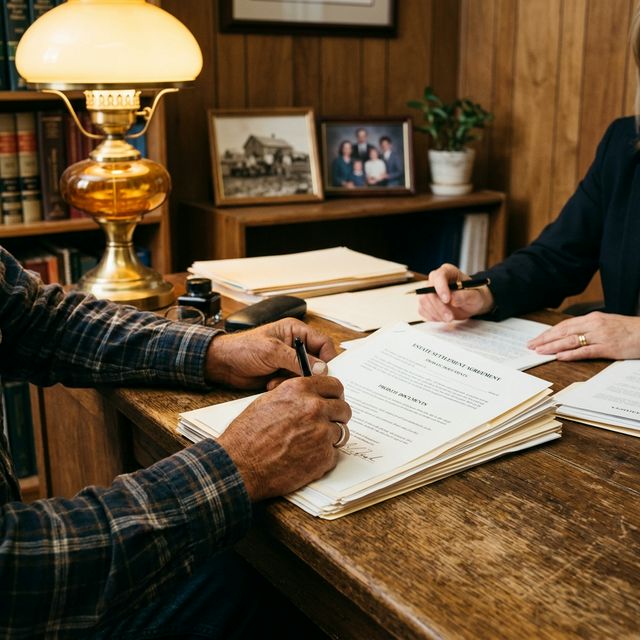
Depending on the planning done before death, your family will face one of two processes.
Required if there is a Will, or if there is no plan at all. This is a public court process. Typical timeframe: 6 to 18 months.
Filing the Will and asking the judge to officially appoint the Personal Representative (Executor) so they have the legal authority to act.
Gathering all farm assets, obtaining appraisals, and publishing public notices to creditors who have a defined window to make claims.
Settling valid debt (operating notes, equipment loans) and filing necessary federal and state estate/income tax returns.
Transferring titles, deeds, and funds to the heirs, and petitioning the court to officially close the estate.
If the farm was placed in a Revocable Living Trust, probate is completely bypassed. Typical timeframe: 3 to 9 months.
The Successor Trustee steps in immediately with full legal authority. No waiting on a judge, which means the farm keeps running without interruption.
Providing required legal notices to trust beneficiaries and preparing a private accounting of the farm’s assets and liabilities.
Privately settling outstanding farm debts, securing tax clearance letters, and preparing fiduciary tax returns.
Executing Trustee Deeds to transfer land to the next generation according to the Trust’s exact instructions.
If your parents lived in Nebraska but owned farmland in Minnesota, the Nebraska court cannot transfer the Minnesota dirt. You must open a primary probate proceeding in Nebraska, and a secondary (“Ancillary”) probate proceeding in Minnesota.
Because Kole Pederson is licensed in both Nebraska and Minnesota, Midwest Ag Law can handle the entire cross-border process internally. You do not need to hire and coordinate two different law firms.
Filing with the county court, inventorying assets, notifying creditors, managing distributions, and closing the estate — including farm-specific complications most attorneys aren’t equipped for. Learn more →
Minnesota probate has its own rules, timeline, and paperwork. We navigate the registrar, informal vs. formal processes, and real estate transfers that keep the operation intact. Learn more →
If the decedent had a trust, probate may not be necessary — but the trust still needs to be administered. We guide the successor trustee through asset management, distributions, tax filings, and termination. Learn more →
Deeds, title transfers, vehicle titles, bank accounts, and retitling of all assets to beneficiaries.
Managing claims from lenders, vendors, and other parties during the estate settlement process.
When disagreements arise about distribution, we help families find fair solutions outside of court.
If you’ve recently lost a family member and aren’t sure what to do next, call us. We will evaluate the situation at no cost, explain your legal obligations, and take the burden off your shoulders.
Legal services tailored to agriculture
Tell us what's going on. We'll point you in the right direction.
Free Consultation