No obligation. No hourly billing. Tell us a little about the situation and we will reach out.
100% Confidential. Flat-fee pricing.
When someone tiles a field and the water ends up in your pasture, it’s not just an inconvenience — it’s a legal issue. Minnesota drainage law under Chapter 103E governs public ditch systems, drainage authority proceedings, benefit assessments, and the rights and liabilities of affected landowners.
Drainage disputes are deeply personal. They pit neighbor against neighbor, often over issues that have been brewing for decades. A new tile line that overwhelms an existing culvert. A county ditch that hasn’t been maintained in 30 years. An assessment for a drainage improvement that benefits upstream but floods downstream.
We represent landowners in 103E proceedings before drainage authorities, appeal panels, and district court. We also handle private drainage disputes — the neighbor-to-neighbor conflicts over tile outlets, surface water diversion, and culvert sizing.
Our 100% remote service model means you can access a licensed Minnesota attorney for all your water and drainage law needs without driving to Minneapolis or St. Paul.
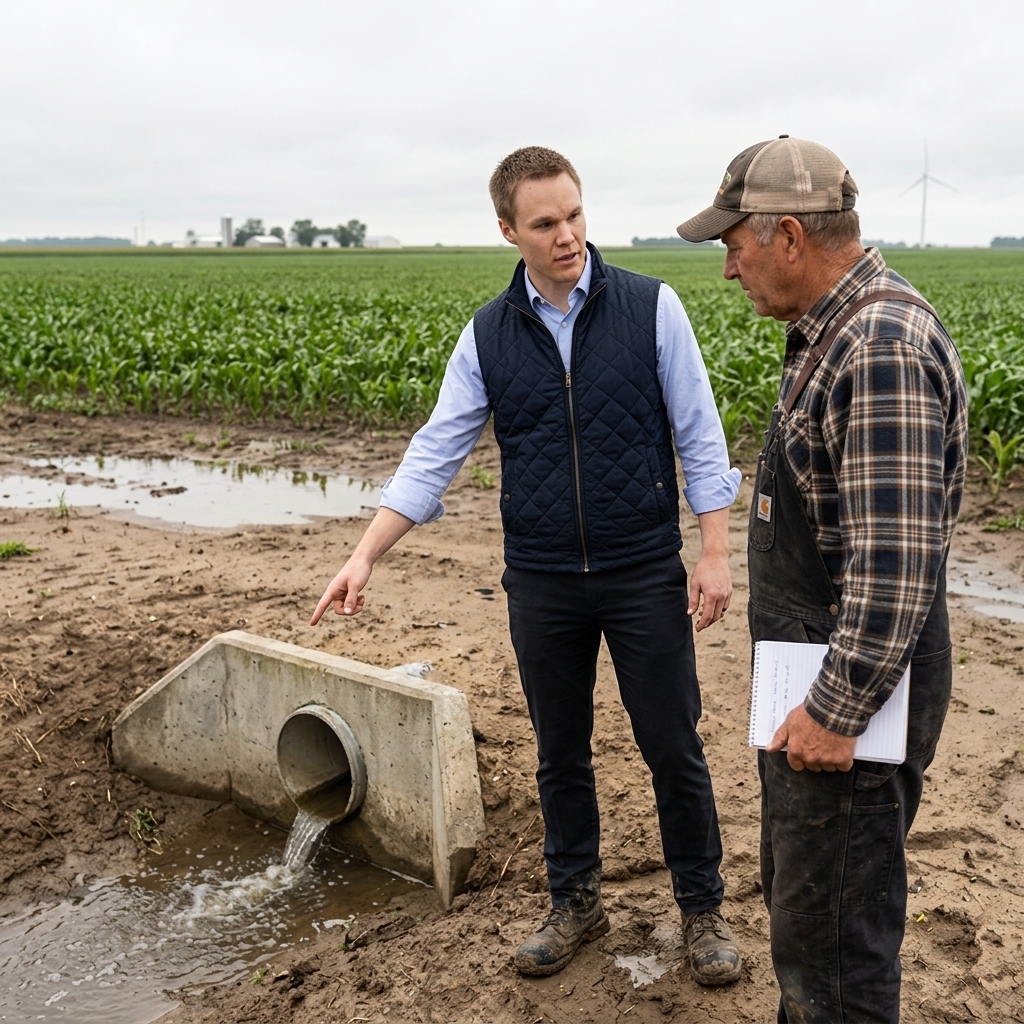
When a county drainage authority proposes an improvement to a public ditch system — larger culverts, deeper channels, new tile mains — the cost is assessed to landowners in the watershed based on the “benefits” they receive from the improvement.
The problem: benefit assessments are often based on outdated engineering studies and don’t accurately reflect who actually benefits. A downstream landowner may be assessed significant sums for an improvement that primarily benefits upstream farmers. A landowner whose property sits at the end of the system may see minimal drainage benefit but still receive a significant bill.
These assessments can be challenged. If your benefit assessment doesn’t accurately reflect the drainage benefit your land receives, we can appeal it through the drainage authority and, if necessary, through district court.
We’ve successfully reduced or eliminated assessments for landowners who were being charged for improvements that primarily benefited other properties in the watershed.
We don’t do hourly billing, and we don’t hand you a stack of paper and wish you luck. Our process is designed to be transparent, thorough, and completely finished when we’re done.
We evaluate the drainage issue — is it a private neighbor dispute, a public ditch system problem, or a 103E proceeding? Each requires a different legal approach.
We gather evidence: survey data, tile maps, historical aerial photos, drainage records, and engineering reports that support your position.
We pursue resolution through negotiation, drainage authority proceedings, or district court — whichever path is most effective for your specific situation.
Representation in the drainage disputes that shape your land’s value.
We represent landowners before drainage authorities, county boards, and district court in public ditch system disputes and improvement petitions.
Private drainage conflicts over tile outlets, surface water, and culverts. We pursue resolution through negotiation or litigation.
If your benefit assessment for a drainage improvement is unfair, we challenge it through the proper appeals process.
 Posted on Google
 Sandramere Seed & Supply Co.
Trustindex verifies that the original source of the review is Google.
Kole helped us develop HR documents and create some customer forms for our business. Kole really helps put legal language in understandable form. We really appreciate his thorough nature and ability to ask the right questions to uncover issues we had not considered. His agricultural knowledge is extremely valuable. Thanks Kole! We really appreciate you!Posted on Google James JensenWorking with Kole was easy and convenient. He answered all our questions and helped us get our trust established quickly.Posted on Google
 Brandon BoardmanKole's personal experience and understanding in agriculture makes him a great attorney for all of your farms estate planning. He's very prompt, professional and he really cares about your needs. What a great guy.Posted on Google
 Mary MollenhauerWorking with this firm feels less like hiring a lawyer and more like bringing on a strategic partner for your legacy. They truly understand the complexity of multi-generational farming operations and approach every plan with both precision and long-term vision. For families managing significant agricultural assets, this is exactly the kind of counsel you want in your corner.Posted on Google
 Mitch MenderKole is a bright and compassionate attorney. He knows what he is doing!Posted on Google
 Pooja VasudevKole Pederson walks the walk and talks the talk! As a former aerial applicator, he has fully lived the agricultural life so he is qualified to assist farmers, ranchers, and agricultural business owners with their estate planning/probate, business law, and real estate legal needs. Kole is diligent, resilient, and down to earth with a genuine commitment to help clients. In this day and age, when everything has become less tangible and very technological - Kole is the kind of attorney agricultural folks can benefit from having on their side!Posted on Google
 Matt SnobergerKole was easy to work with and has vast knowledge of agriculture and a lot of common sense. One of the easiest people I’ve ever worked with.Posted on Google
 Flynn BakerI have worked with Kole on a legislative and policy committee for a non profit organization. Kole's input was incredibly valuable; especially navigating legal jargon and procedures as well as his attention to detail and timeliness. I am glad to have worked with him and trust his recommendations and actions in legal matters.Posted on Google
 BeckyI was doing an online search for an attorney and ran across Midwest Ag Law. I called and Mr. Pederson actually answered the phone himself, which Never happens these days! Unfortunately, he doesn't do Guardianship cases, but was very kind and went out of his way to give me some referrals!Posted on Google
 Curt FriesenLegal work made simple. Very professional firm that delivered everything I needed, when I needed it, and at a reasonable price. Great to work with and will use them again.Verified by TrustindexTrustindex verified badge is the Universal Symbol of Trust. Only the greatest companies can get the verified badge who has a review score above 4.5, based on customer reviews over the past 12 months. Read more
Water issues don’t get better on their own. Schedule a free consultation. 100% remote service for Minnesota landowners.
Legal services tailored to agriculture
Tell us what's going on. We'll point you in the right direction.
Free Consultation